Parent educator and mentor MARY WILLOW thinks so, saying some of our modern parenting habits give kids too much choice, too early, resulting in stress and anxiety.
For decades, Mary Willow has been studying what she calls the ‘true child’ and the ‘guard dog’ – two distinct parts of a child’s brain that respond very differently to the world. Her new book, Breaking Through: How to Rescue Childhood and Heal the Parent-Child Relationship, follows on from her work as a nurse, midwife, early childhood teacher, and especially at Plum Parenting, where she has had a 10- to 12-month waiting list for her parent mentoring and educating services for 16 years.
“The true child is open,” she explains. “They are enthusiastic and curious and want to connect.”
But the guard dog – which refers to the brain’s defence system – is something else entirely.
“Its mandate is me first, me only. I’ve got to just look after my own safety and security. Don’t know about you. Don’t care about you. Get me to safety now.”
The problem, Mary says, is that many modern parenting habits inadvertently empower this guard dog rather than the true child. And when the guard dog is in charge, learning is difficult. It will treat everyday life as a threat.
“You can’t learn if you’re in a guarded, closed state,” Mary says.
The rise of permissive parenting – and the hidden consequences
Mary believes the shift away from more punitive parenting has had unintended consequences.
“We swung over to permissive as a reaction to the negative fallout from punitive,” she says. “But both of these styles of parenting actually empower the wrong part of the child.”
Punitive parenting activates fear. “You’re taking a stick to the dog,” she says. “What’s a dog like if you take a stick to it? It’s anxious and either going to close off or else be aggressive and unpredictable.”
But permissive parenting – often seen as gentle, child‑led, and respectful – can also backfire.
“We have handed over the developmental pathway to this guard dog brain,” Mary says.
“If we give (too many) choices to children when they’re little, we can by mistake actually give all that empowerment to the guard dog instead of the true child.”
The result? A child who becomes hardwired for anxiety, less open, risk averse and increasingly rigid in their responses to challenges.
“Its job is to be anxious and hyper‑vigilant and on alert all the time,” she says.
Are we asking too much of little ones?
One of Mary’s most striking observations is how overwhelmed young children become when asked to make constant decisions.
“Do you want to eat this? Do you want to wear that? Are you tired now? Do you want to go to bed?” she says.
“The young child is just saying to the adults, ‘put me in your boat, take me for the ride, show me what life is’.”
Instead, she says, we are “accelerating childhood” and expecting children to navigate choices they are not developmentally ready for.
“All of those choices are actually a burden. These children are exhausted.”
And when overwhelmed, children melt down repeatedly: “they’re hardwiring melting down as habitual,” Mary says.
Why boundaries reduce anxiety
Mary argues that clear, simple boundaries are not restrictive – they are protective.
“I love to talk about boundaries as being like a delicious paddock of freedom,” she says.
Children thrive when they know the edges of that paddock. “Stop means stop. No means no. Go means go.”
These boundaries help the guard dog settle into the back seat, allowing the true child to come forward – the part of the brain capable of learning, connecting, and regulating emotions. Bringing this part forward means children become more resilient, as they realise they can deal with challenges, moving from reactive to responsive.
Can parents still turn things around?
The good news, Mary says, is that it’s never too late to change the way you are parenting.
“You can walk it back,” she says. The key is to work with both parts of the child: “You’ve got to first take your doggy to puppy school… and then take your true child by the hand and say come with me babe, let me show you life.”
Puppy school means starting small – not letting them run wild, but introducing considered changes one step at a time.
Introduce simple routines, clearer boundaries, and more structure in the day – such as getting dressed as soon as the child gets up – not after watching TV- and starting the day by connecting through having breakfast together. Think of it as “shaping the riverbed,” Mary says, creating a steady framework so life flows more smoothly.
Most importantly, remember your role: “I’m the captain of the ship.” Children don’t need you to hand them control too early – they need you to guide them safely until they’re ready.
Dealing with anxiety and building resilience
When anxiety shows up, don’t shut it down. “I’m not for stopping tantrums,” Mary says. “It is okay for a child to feel their feelings and throw their toys.”
She says one of the biggest contributors to anxiety is shielding children from difficulty. While it’s natural to want to protect them, constantly removing challenges sends the wrong message: that they can’t cope.
Let them offload – then guide them through. “I hear you darling, I understand… but now we’re going to work it through.”
“Life is going to be hard,” she says. “I’m right here beside you… but I’m not going to facilitate you escaping what’s difficult. I’m going to help you work it through and become strong and resilient.”
This approach builds confidence. It teaches children that discomfort is temporary – and manageable.
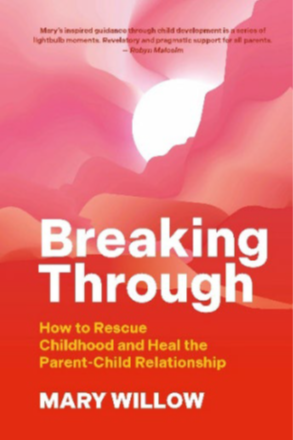
Breaking Through, by Mary Willow. Bateman Books. Published June 2026. RRP: $45.
Read more: Anxiety – Is your child sick with worry >>